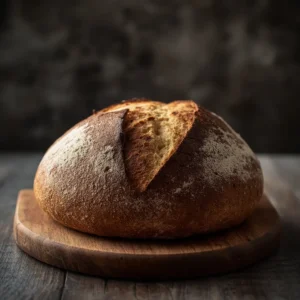
Homemade Sourdough Bread
Bake incredible Homemade Sourdough Bread with a crispy crust and a delightfully chewy interior using simple ingredients and our expert guidance.
Ingredients
For the Sourdough Bread
- 100 grams active sourdough starter fed 4-12 hours prior
- 350 grams warm water 90-95°F / 32-35°C
- 500 grams strong bread flour high protein, 12-14%
- 10 grams fine sea salt
Equipment
- Large mixing bowl
- Dough scraper
- Banneton basket or bowl lined with floured kitchen towel
- Dutch oven with lid 5-7 quart capacity
- Razor blade or lame for scoring
Instructions
- Feed Your Starter & Autolyse: In a large bowl, combine the warm water and active sourdough starter. Stir gently to combine. Add the bread flour and mix until no dry streaks remain, forming a shaggy dough. Cover the bowl and let it rest for 30-60 minutes at room temperature. This process, called autolyse, allows the flour to fully hydrate and gluten to begin developing without salt.
- Add Salt & Perform Stretch and Folds: Sprinkle the salt over the dough. Using wet hands, gently incorporate the salt by squeezing and folding the dough. Over the next 2-3 hours, perform 3-4 sets of 'stretch and folds' every 30-45 minutes. To do this, grab a portion of the dough, stretch it upwards, and fold it over itself. Rotate the bowl and repeat 3-4 times per set. This builds strength and elasticity in your Homemade Sourdough Bread.
- Bulk Fermentation (First Rise): After the stretch and folds, cover the bowl and allow the dough to bulk ferment at room temperature (72-78°F / 22-25°C) until it has increased in volume by about 30-50% and feels airy and bubbly. This usually takes 4-8 hours, depending on your starter's activity and ambient temperature. This is where most of the flavor develops.
- Pre-Shape & Rest: Gently tip the dough out onto a lightly floured surface. Divide the dough if making multiple loaves. Using a dough scraper and your hands, gently form the dough into a loose round (a 'boule') or oval (a 'batard'). Avoid degassing too much. Cover loosely and let it rest for 20-30 minutes. This helps the gluten relax for final shaping.
- Final Shape & Cold Proof: Lightly flour a banneton basket (or a bowl lined with a floured kitchen towel). Gently shape the dough into its final desired form, building tension on the surface. Transfer the shaped dough seam-side up into the prepared banneton. Cover tightly with plastic wrap or a shower cap and refrigerate for 12-18 hours. This cold proof slows fermentation, enhances flavor, and makes the dough easier to score.
- Preheat Oven & Dutch Oven: About an hour before baking, place your Dutch oven (with its lid) into your oven and preheat to 475°F (245°C). Ensuring the Dutch oven is fully preheated is crucial for achieving that signature crisp crust and oven spring. Patience here is key for a perfect bake.
- Score & Bake (Covered): Carefully remove the hot Dutch oven from the oven. Gently invert the cold dough from the banneton directly into the hot Dutch oven. Using a razor blade or lame, score the top of your Homemade Sourdough Bread with your desired pattern (a single deep slash or an intricate design). Cover with the lid and bake for 20 minutes.
- Bake (Uncovered) & Cool: After 20 minutes, remove the lid from the Dutch oven. Reduce the oven temperature to 450°F (230°C) and continue baking for another 25-30 minutes, or until the crust is deeply golden brown and the internal temperature reaches 200-210°F (93-99°C). Carefully remove the loaf from the Dutch oven and cool completely on a wire rack for at least 2 hours before slicing. This allows the crumb to set and moisture to redistribute, preventing a gummy texture.
Notes
- Use a kitchen scale for accurate measurements; sourdough is precise.
- Don't be afraid to experiment with different flour blends for unique flavors.
- Observe your dough, not just the clock, as fermentation times vary.
- A cold proof is your friend for both flavor and ease of handling.